AI now beats doctors at diagnosis in the lab. So why don't doctors get better when they use it?
In 2026, two papers in Science, one of the most respected journals in the world, reported that artificial intelligence diagnosed difficult medical cases better than physicians. The headlines were loud: "AI out-diagnoses doctors." But a quieter set of studies points to a stranger problem. When doctors are handed the same AI, they barely improve.
So who is right? And what does this mean for you as a health student?
The headline numbers
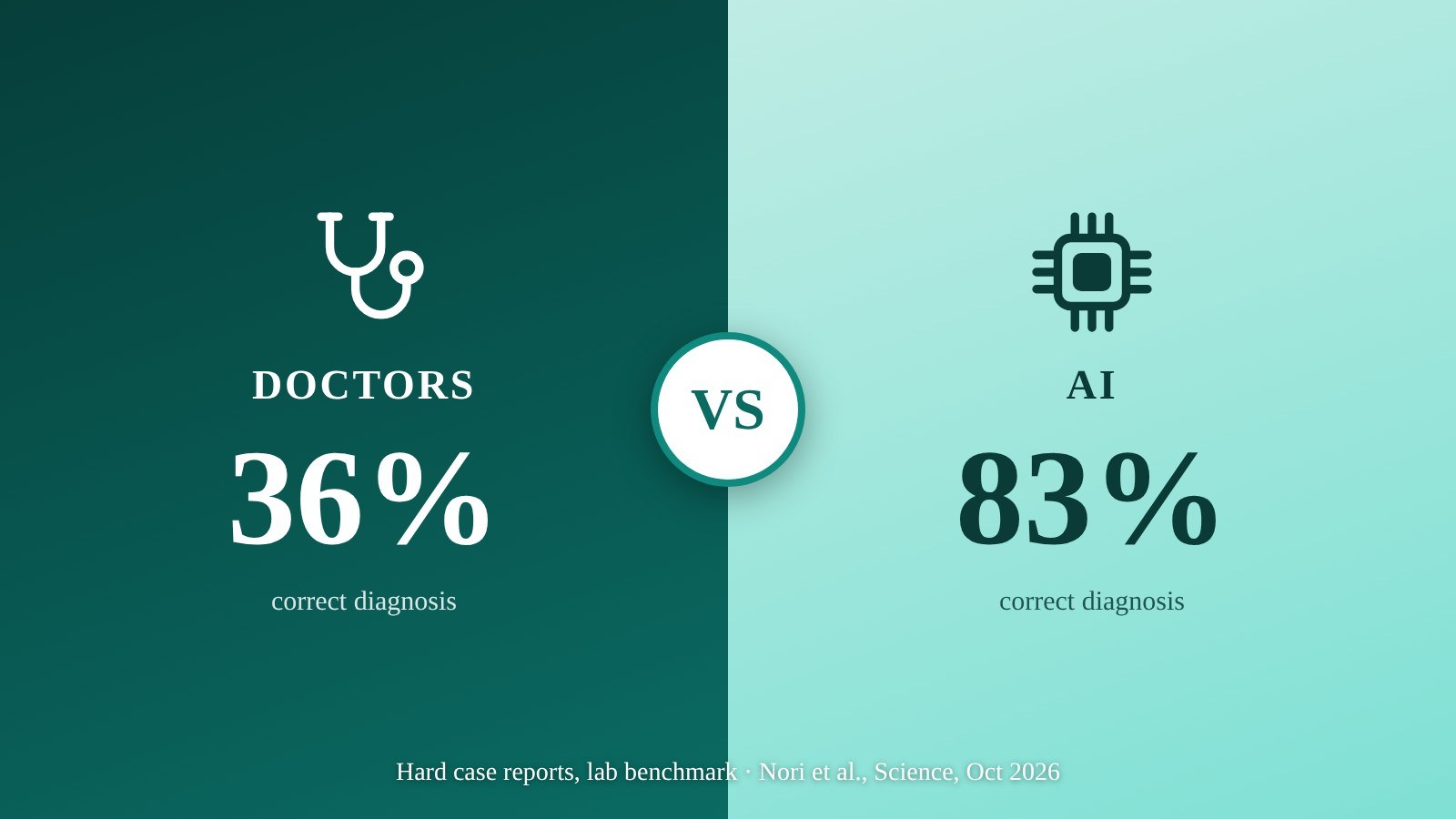
Microsoft's "panel of doctors" AI (October 2026). A Microsoft team built an AI system that acts like a group of physicians: it asks questions, orders tests one by one and keeps revising its list of possible diagnoses. They tested it on complex case reports from the New England Journal of Medicine. The system reached the correct diagnosis in 83.2% of cases, compared with 36.1% for generalist physicians. On emergency department admissions, it scored 80.3% against 46.8% for the physicians (Nori et al., Science, 22 Oct 2026).
Harvard and Beth Israel (April 2026). Researchers compared an OpenAI reasoning model with hundreds of physicians across five experiments, then ran a real-world test with randomly selected patients in the emergency room of a large Boston hospital. In every experiment, the AI did better than the physician baseline. The authors concluded that AI has passed most tests of clinical reasoning, and that real prospective trials are now urgently needed (Brodeur et al., Science, 30 Apr 2026).
What the headlines left out
- The comparison doctors were generalists. In the Microsoft study, the AI was compared with primary care doctors and general internists working alone. The specialists and teams who usually handle cases this complex were not tested.
- It was a benchmark, not a hospital. The Microsoft authors say themselves that the results come from a controlled benchmark setting.
- Text only. The AI read written case notes. Real doctors also see how sick a patient looks, hear their story change and examine them.
- The Harvard study did not compare AI with emergency doctors. Its human comparators were internal medicine physicians, and its own authors do not say AI should replace doctors.
The twist: doctors with AI did not improve much
Back in 2024, a randomised trial at several US medical schools gave 50 physicians up to six difficult cases. Half could use an AI chatbot; half used normal resources. Doctors with AI scored 76%, doctors without it 74%: no real difference. But the AI alone scored 16 percentage points higher than the doctors without it (Goh et al., JAMA Network Open, 2024).
A UK team repeated the experiment with 22 physicians in 2026. This time, AI access did help (74.3% vs 65.7%). Yet doctors using AI still scored 21.3 points lower than the AI on its own. The reason was surprising: doctors put only 30% of the case questions to the AI at all (Healy et al., Diagnosis, 2026).
In other words, the problem may not be the AI. It may be how humans work with it: when we trust it, when we ignore it, and when we never think to ask.
Why this matters to health students
These studies do not show that AI can replace doctors, physiotherapists or nurses. They show that AI is now very strong at one narrow task, reasoning through written cases, and that health professionals have not yet learned how to use it well. That gap is exactly where new research is needed, and where your generation will work.
Thesis ideas this opens
- Do clinicians in Egypt or the Gulf use AI for clinical questions, and how much do they trust it? A survey of doctors, physiotherapists or nurses.
- Does a short training session change how well students use AI on clinical cases? A simple before-and-after or randomised study with vignettes.
- How accurate is AI on physiotherapy cases? Compare AI answers with expert physiotherapists on written cases from your own specialty.
- Over-trust and under-trust: when do students accept a wrong AI answer, and when do they reject a right one?
Before you register any of these, check whether it has already been done. You can check your thesis idea for free on Neura: it shows you the closest published studies.
Sources: Nori H, et al. Sequential diagnosis with language models. Science. 2026;394:423-428. https://doi.org/10.1126/science.aeh7930 · Brodeur PG, et al. Performance of a large language model on the reasoning tasks of a physician. Science. 2026;392:524-527. https://doi.org/10.1126/science.adz4433 · Goh E, et al. Large Language Model Influence on Diagnostic Reasoning: A Randomized Clinical Trial. JAMA Netw Open. 2024;7(10):e2440969. https://doi.org/10.1001/jamanetworkopen.2024.40969 · Healy J, et al. Human-AI collaboration in clinical reasoning: a UK replication and interaction analysis. Diagnosis. 2026. https://doi.org/10.1515/dx-2025-0176