Egyptian and Arab university rankings in research 2026: where does your university stand?
Every year we see headlines like "Cairo University is number one" or "an Arab university enters the world's top 100". But many students don't know what these rankings actually measure, or where Egypt and the Arab world stand in high-quality research.
Here are the latest numbers from the four best-known global rankings, each with its source.
First: how the rankings differ
- Nature Index counts only papers published in a selected group of top science journals. It measures research quality, not volume.
- QS is an overall university ranking: research, academic reputation, employer reputation and international students.
- THE (Times Higher Education) is also an overall ranking, with a special Arab edition.
- SCImago is based on research, innovation and societal impact, and covers thousands of institutions worldwide.
In short: to see who publishes the strongest research, look at Nature Index. For the overall picture of a university, look at QS and THE.
Arab countries in the Nature Index 2026
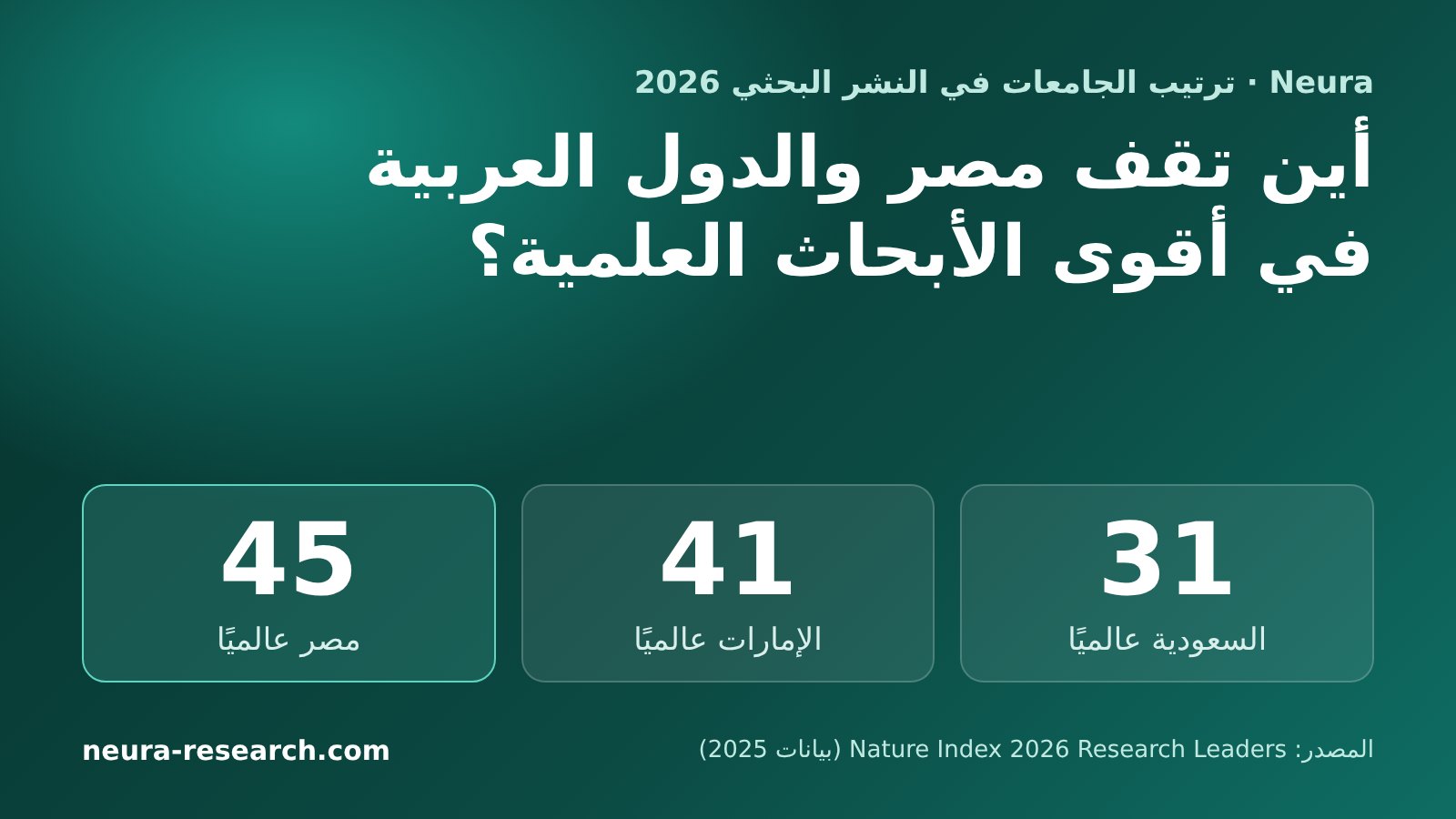
In the Nature Index 2026 Research Leaders tables, based on research from the full year 2025 (Nature Index):
| Country | World rank | Papers in 2025 | Change from the year before |
|---|---|---|---|
| Saudi Arabia | 31 | 881 | down 12% |
| UAE | 41 | 394 | up 0.6% |
| Egypt | 45 | 396 | down 17% |
No other Arab country appears in the top 50 of this table.
Egyptian universities in the Nature Index 2026
According to Ain Shams University, Egypt ranked 2nd in Africa and 45th in the world, with 379 papers published between April 2025 and March 2026 (Ain Shams University).
The leading Egyptian universities in high-quality research, in order:
- Ain Shams University
- Cairo University
- Assiut University
- Then Tanta, Helwan and Mansoura universities
Egypt by field: applied sciences 37th in the world (1st in Africa), biological sciences 48th, health sciences 52nd, chemistry 54th.
Egypt's main research partners in these papers: China, the United States, the United Kingdom, Japan and Saudi Arabia.
The best Arab universities for research
Nature Index (2024 research): King Abdullah University of Science and Technology (KAUST) ranked 2nd among all academic institutions in Western Asia. The next Arab universities were King Saud University (7), Khalifa University (10), NYU Abu Dhabi (11), King Fahd University of Petroleum and Minerals (16), Qatar University (18), Hamad Bin Khalifa University (29) and Sultan Qaboos University (33) (Nature Index).
THE Arab University Rankings 2027 (published October 2026): KAUST is first for the fourth year in a row, followed by Hamad Bin Khalifa University in Qatar, then King Fahd University of Petroleum and Minerals (Times Higher Education).
QS World University Rankings 2026: for the first time, an Arab university entered the world's top 100: King Fahd University of Petroleum and Minerals, 67th. Next among Arab universities: Qatar University (112), King Saud University (143), King Abdulaziz University (163) and Khalifa University (177) (Al-Fanar Media).
Egyptian universities in QS 2026
20 Egyptian universities are in QS 2026 (Al-Fanar Media):
| University | World rank |
|---|---|
| Cairo University | 347 (1st in Egypt) |
| The American University in Cairo | 381 |
| Ain Shams University | 542 |
| Alexandria University | 781–790 |
Egypt publishes a lot, but what about quality?
This is the key point. Cairo University alone published more than 7,500 papers in 2025, according to Scopus, and 48.1% of them were with international co-authors (Masrawy).
But in the Nature Index, which counts only papers in the top journals, Egypt's share fell by 17% in one year. And in QS, no Egyptian university is in the top 800 for citations per faculty, an indicator of how much other researchers use and cite a university's work.
In other words: Egypt publishes many papers, but only a small share reach the top journals or get widely cited.
What this means for you as a master's or PhD student
- Start from a real research gap. Top journals reject studies that repeat what has already been done.
- Get the methods right. A justified sample size and correct statistics are the first things reviewers check.
- Think about international collaboration. Almost half of Cairo University's papers had co-authors from outside Egypt.
- Plan for publication from day one of your thesis, not after your defence.
How Neura helps
Before you register your thesis idea, you can check it for free on Neura to see whether it has been studied before, with the closest published studies and the research gap. Neura can also calculate your sample size and write the Methods paragraph in a way reviewers accept.
The figures in this article come from the latest ranking editions we could verify as of November 2026. Rankings use different methods and time periods, so their numbers should not be compared directly.