Up to 350,000 EGP for your PhD: where to find research funding in Egypt and the Gulf
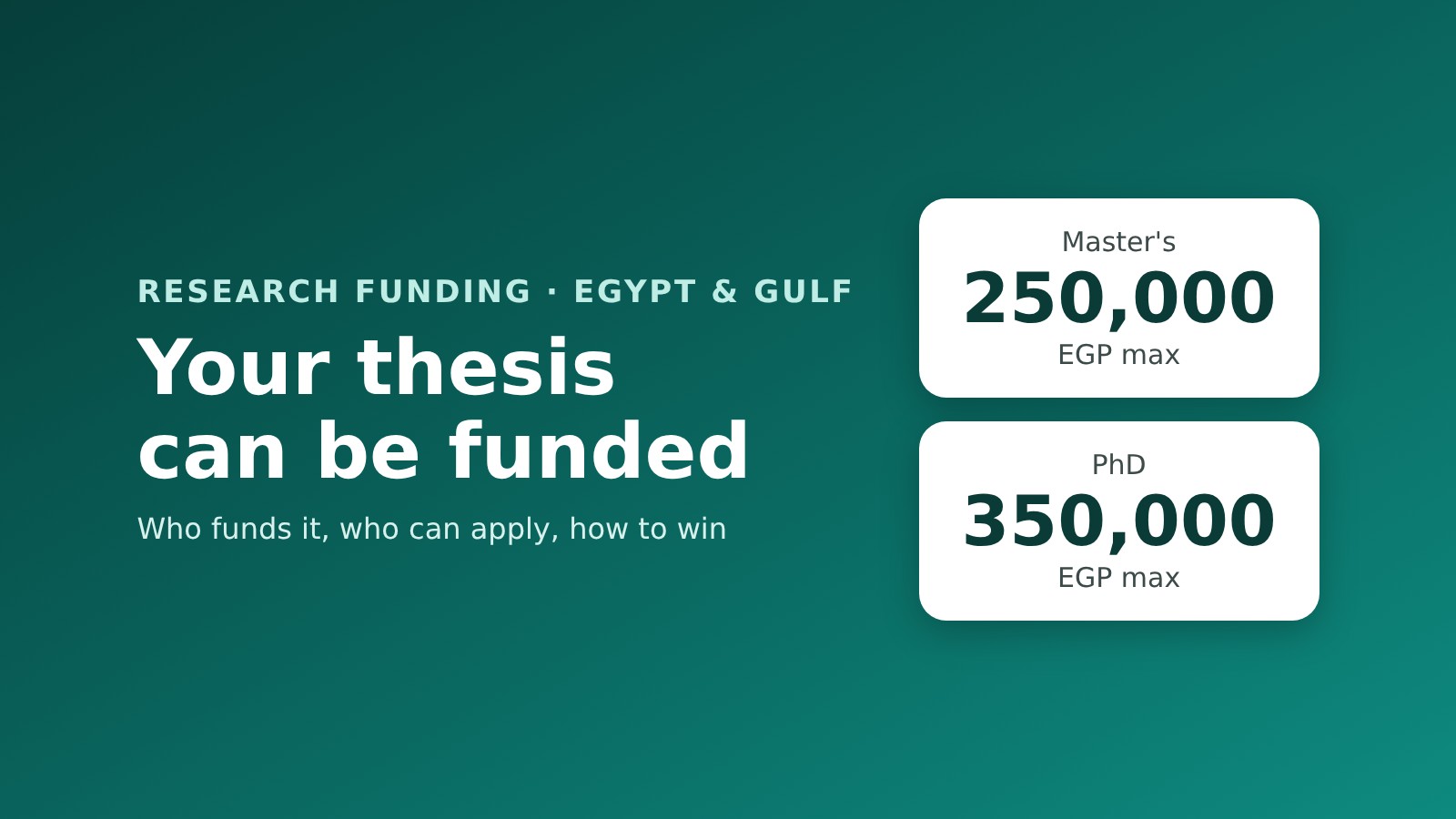
Most postgraduate health students in Egypt pay for their thesis themselves: the tests, the equipment, the statistics, the printing. Meanwhile, Egypt's own research funders offer up to 250,000 EGP for a master's and up to 350,000 EGP for a PhD. Many students simply never hear about the calls, or hear too late.
This guide shows you where the money is, who can apply, and how to write a proposal that wins.
Egypt: the two big funders
1. The Academy of Scientific Research and Technology (ASRT)
- Master's and PhD grants ("GROWTH – Step by Step"). In the 2026 cycle, ASRT announced grants of up to EGP 250,000 for a master's and up to EGP 350,000 for a PhD, with a deadline of 31 May 2026 (Ministry of Higher Education announcement, March 2026).
- PRISM: health and biomedical research. A national programme with three tracks: health innovation and prototypes, clinical research, and translational research. The 2026 priorities included oncology, obesity and metabolic health, infectious diseases and antimicrobial resistance, and digital health, AI and medical technology. The 2026 call opened on 1 February and closed on 15 April (Ain Shams University notice).
- RESPECT. Up to EGP 3 million over two years for senior scientists who run projects with young researchers on the team. Ask your supervisor if they are applying: being named on a funded project is one of the best things for your CV.
2. The Science, Technology and Innovation Funding Authority (STDF)
- Graduate student funding. STDF has run calls that fund the best master's and PhD research plans of Egyptian students in scientific faculties, with ceilings of EGP 250,000 (master's, up to 2 years) and EGP 350,000 (PhD, up to 3 years). Applicants needed to have finished their preliminary courses first (Mansoura University notice).
- Postdoctoral fellowships in France (with the French Embassy). Six months in a French lab, with airfare, living costs and insurance covered. Health and medical research is eligible. In the 2026 call, applicants had to be Egyptian, hold a PhD from the last 10 years and be 45 or younger (Fayoum University notice).
The Gulf
- UAE: Al Jalila Foundation Seed Grants. For UAE-based researchers (nationals and residents) with an institutional affiliation, funding health and medicine projects for up to two years, including diabetes, obesity, heart disease, cancer, mental health and infectious diseases. The 2025/2026 round is closed; watch for the next one (Al Jalila Foundation).
- Saudi Arabia: Research, Development and Innovation Authority (RDIA). Research grants on national priorities, which include health and wellness, open to researchers and faculty at Saudi universities. The Saudi Emerging Investigator Program supports early-career researchers' first projects (Saudi Gazette).
- Qatar: QRDI Council / Qatar National Research Fund. The Graduate Student Research Award (GSRA) lets local institutions sponsor future researchers for a master's or PhD, and a precision medicine call runs with the Qatar Genome Programme (Gulf Times).
- Kuwait: Kuwait Foundation for the Advancement of Sciences (KFAS). A Young Researcher Grant for students and researchers without a PhD, listed with a ceiling of KWD 5,000 for Kuwaiti citizens (grant listing).
Important: calls open and close every year, and rules change. The dates above are from the latest cycles we could verify. Always check the funder's own website and your faculty's research office before you apply.
When to look
In 2026, the deadlines of most of Egypt's big calls fell between January and May. So the best time to prepare is now: by January you should have your idea, your gap and a first draft of the proposal ready.
7 things a winning proposal needs
- A real research gap. Reviewers reject ideas that have already been done. Show the closest published studies and what is still missing.
- A clear question in PICO form: population, intervention, comparison, outcome.
- A justified sample size. Say which test, effect size, power and alpha you used, and cite where the effect size came from.
- A realistic budget. Every item linked to an aim: tests, devices, participant travel, statistics, publication fees.
- A timeline with milestones you can actually meet.
- Ethics approval planned from the start.
- Impact for your country: why this matters for patients and the health system in Egypt or the Gulf.
Where Neura helps
The two parts reviewers check first are the gap and the sample size. You can check whether your idea has already been done, for free, and Neura shows you the closest published studies. Neura can also calculate your sample size and write the Methods paragraph that explains it.
This guide is for information only. Funding rules, amounts and deadlines change every cycle; confirm everything with the funder before applying.