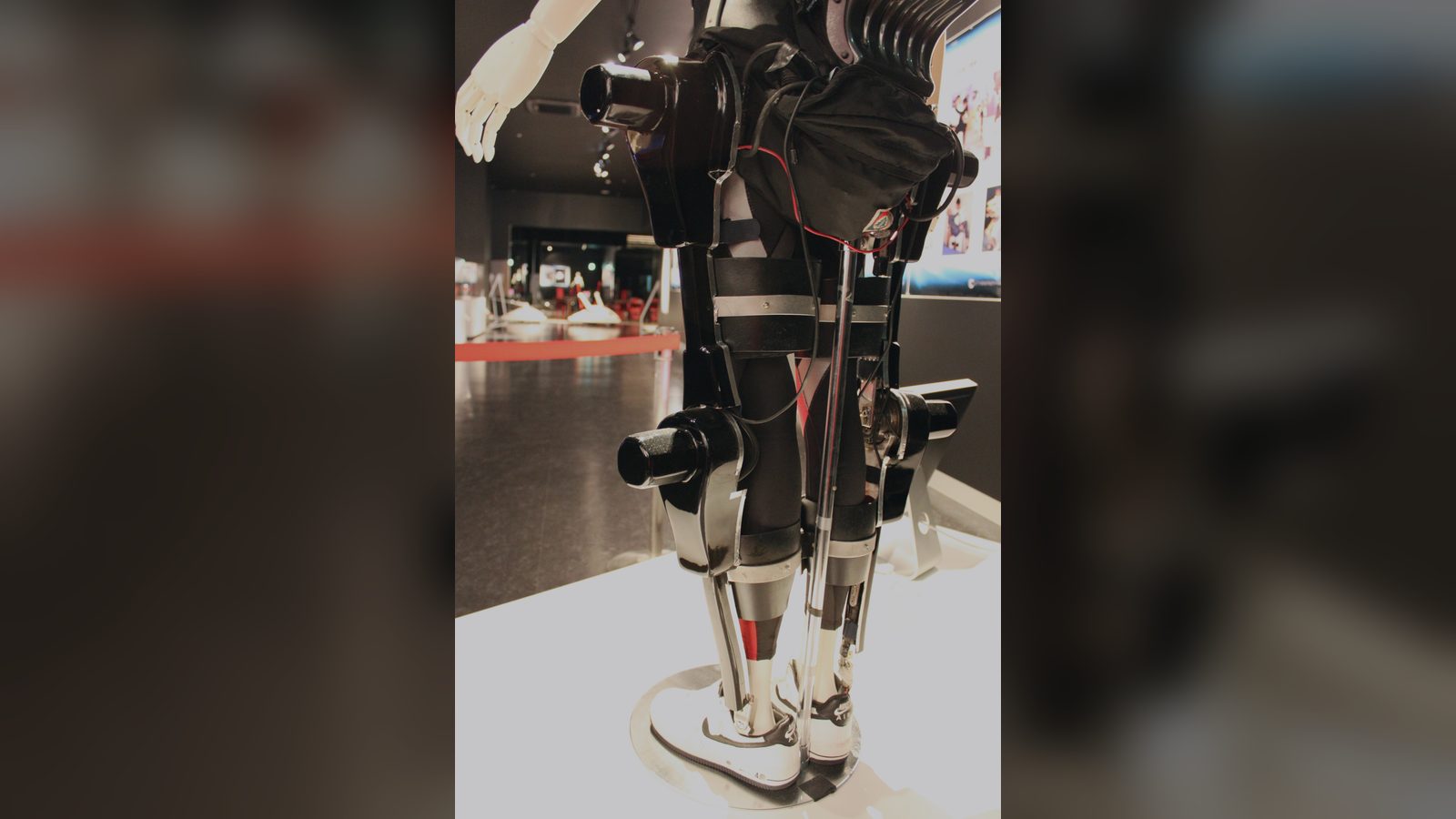
A robot suit helped stroke patients walk better within days — but the study had only 4 patients
Can a wearable robot help people walk again in the first weeks after a stroke? A team at Tokushima University Hospital in Japan tried to answer this with the Hybrid Assistive Limb (HAL), a robotic exoskeleton worn on the legs. Their results were published on 23 October 2026 in the journal Frontiers in Neurorobotics.
What is HAL?
HAL is a motorised suit made by the Japanese company Cyberdyne. It picks up the tiny electrical signals from the user's leg muscles and moves the hip and knee joints in time with what the person is trying to do. The idea is simple: help the patient practise a more normal walking pattern, many times, early in recovery.
What did the researchers do?
- Who: 4 patients in the acute phase of stroke (one bleed, three clots), aged 52 to 76, all with weakness on one side.
- Training: 20-minute walking sessions, twice a day, five days a week, for three weeks. Some sessions used HAL; the others were normal physiotherapy gait training.
- Measure: a 10-metre walk test before and after every session, giving walking speed, step length and steps per minute.
- In total, 51 sessions were analysed: 31 with HAL and 20 conventional.
What did they find?
- Right after HAL sessions, patients took longer steps and walked faster. These within-session changes were statistically significant.
- After conventional sessions, there was no significant change.
- But when HAL was compared directly with conventional training, the extra gain was small — about 0.03 m/s faster and 1.6 cm longer steps — and not statistically significant (the 95% confidence intervals included zero).
- An exploratory look suggested that slower walkers (0.4 m/s or less) gained more from HAL than faster walkers.
Why this is still early evidence
This is a pilot study, and the authors say so clearly:
- Only 4 patients. Most of the 51 "sessions" came from the same people, so they are not independent.
- Not randomised, and only the outcome assessor was blinded.
- Immediate effects only. Nobody knows yet whether the gains last a week, a month or a year.
- The subgroup finding for slow walkers is exploratory — a clue to test, not a conclusion.
In short: an interesting signal, not proof. The authors call for larger randomised trials.
What it means for physiotherapy students
This study is a perfect example of how to read a paper carefully. A headline could say "robot suit improves walking after stroke", but the real comparison between groups was not significant. Always look at the sample size, the comparison group and the confidence intervals, not only the p-values inside one group.
It also points to thesis ideas. Robotic devices are expensive, but the questions are universal: does early, high-repetition gait training help more than usual care? Do slow walkers benefit most? A well-designed randomised trial with a proper sample size — for example comparing body-weight-supported treadmill training with conventional gait training in acute stroke — is the kind of study the field is asking for.
Before you register an idea like this, check whether it has already been done — Neura can search the published studies and your faculty's previous theses for you.